
nikon fm2 manual
Nikon FM2 Manual: A Comprehensive Guide
Discover detailed service, repair, and maintenance procedures for your Nikon FM2, FM2n, or FM2/T with this comprehensive digital workshop manual.
The Nikon FM2, released in 1982, quickly became a legendary 35mm SLR celebrated for its mechanical reliability and exceptional build quality. This camera represents a pinnacle of traditional film photography, offering a robust and dependable experience for enthusiasts and professionals alike. Unlike many contemporary cameras, the FM2 operates entirely mechanically – requiring only a battery for the light meter, making it incredibly resilient in diverse conditions.

Its enduring appeal stems from its simplicity, durability, and accurate metering system. The FM2 is an AI-type camera, fully compatible with Nikon’s AI and AI-S lenses, utilizing full-aperture metering for precise exposure control. This manual serves as a comprehensive resource, guiding users through every aspect of the FM2, from understanding its controls to performing basic maintenance and troubleshooting common issues. It’s a gateway to unlocking the full potential of this iconic camera.
Key Features and Specifications
The Nikon FM2 boasts a horizontally-traveling focal-plane shutter with speeds ranging from 1 to 1/4000th of a second, plus Bulb mode. It accepts standard 35mm film and features a full-aperture metering system when used with AI-type lenses, utilizing meter coupling ridges for accurate readings. The viewfinder offers approximately 93% coverage, aiding in precise composition.
Key specifications include a top shutter speed of 1/4000s, ISO range of 12-3200, and compatibility with Nikon’s extensive range of AI and AI-S lenses. The camera’s mechanical operation ensures reliability, needing a battery solely for the meter. Its robust construction and precise engineering contribute to its legendary status. The FM2/T variant included a built-in flash, expanding its versatility. This camera is a testament to Nikon’s commitment to quality and performance.
Understanding the Camera Body
The Nikon FM2’s body is primarily constructed from metal, providing exceptional durability and a solid feel. Its compact size belies its robust functionality. The top deck houses the shutter speed dial, film advance lever, and rewind crank. The back panel features the film counter, exposure compensation dial, and a clear, bright viewfinder window.
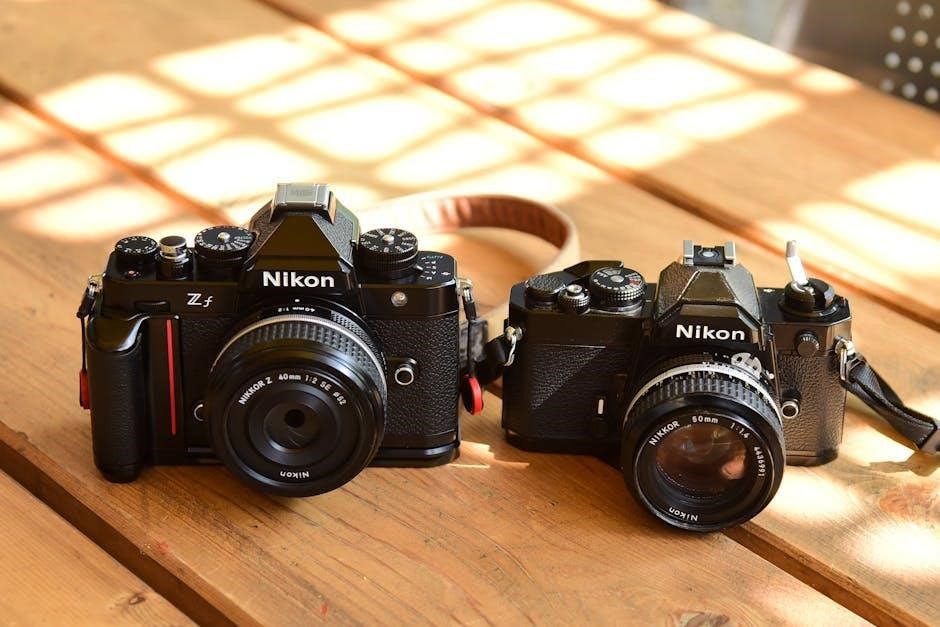
Essential elements include the battery compartment located on the camera’s bottom, and the standard tripod socket. The film chamber is accessed via a hinged back door. Familiarizing yourself with the placement of these components is crucial for efficient operation. The camera’s design prioritizes accessibility and ease of use, making it a favorite among both amateur and professional photographers. Its intuitive layout encourages exploration and mastery.
Viewfinder and Focusing Screen
The Nikon FM2’s viewfinder offers a bright and clear view of the scene, displaying approximately 93% coverage. Within the viewfinder, you’ll find the focus spot, microprism collar, and split-image rangefinder – all aiding in precise focusing. The focusing screen itself is interchangeable, allowing users to customize it based on their preferences.
Accurate focusing is achieved by aligning the image within the split-image rangefinder or utilizing the microprism collar. When properly focused, the split-image will appear as a single, unified image. The viewfinder also displays essential exposure information, including the over/under exposure indicators when using aperture priority metering. Understanding these indicators is key to achieving correctly exposed photographs.
Controls and Dials: A Detailed Overview
The Nikon FM2 features a straightforward control layout. The shutter speed dial, located on the top plate, allows manual selection from 1 to 1/2000th of a second, plus Bulb (B) for long exposures. Adjacent is the film speed (ISO) dial, coupled to the metering system. The aperture ring is controlled directly on the lens itself, crucial for aperture-priority metering.
Other key controls include the film advance lever, which also cocks the shutter, and the rewind crank for film retrieval. The depth-of-field preview lever stops down the lens to visualize the area in focus. The self-timer button initiates a 10-second delay. Mastering these dials and controls is essential for fully utilizing the FM2’s capabilities.
Loading and Unloading Film
To load film, open the camera back using the film rewind knob. Insert the 35mm film cartridge into the left-side chamber and pull the film leader across to the take-up spool on the right. Ensure the film perforations engage with the sprockets. Advance the film and check it’s catching correctly. Close the camera back securely.
For unloading, press the film rewind button on the bottom plate. Turn the film rewind knob in the direction of the arrow until the film is fully retracted into the cartridge. Open the camera back and remove the film. Proper loading and unloading prevent damage to the film and camera mechanism, ensuring optimal performance.
Metering System Explained
The Nikon FM2 utilizes a center-weighted averaging metering system, prioritizing light measurement in the central area of the frame. This system functions effectively with AI-type lenses, utilizing the aperture rings’ meter coupling ridges for accurate exposure calculation. The viewfinder displays a needle indicating exposure deviation – centered means correct exposure.
Understanding the needle’s position is crucial. “+” indicates overexposure, while “-” suggests underexposure. Adjust aperture or shutter speed accordingly to center the needle. The FM2’s reliable metering ensures properly exposed photographs in various lighting conditions, offering both manual and aperture-priority metering modes for versatile control.
Metering Modes and Operation
The Nikon FM2 primarily operates in aperture-priority metering. You select the desired aperture, and the camera automatically sets the appropriate shutter speed for correct exposure, indicated by the viewfinder’s needle. Manual metering allows full control over both aperture and shutter speed, requiring you to interpret the meter reading and adjust settings accordingly.
To utilize the metering system, ensure the light meter is activated – typically by half-pressing the shutter release. Observe the needle; centering it guarantees proper exposure. Remember the center-weighted pattern, favoring the frame’s center. Understanding these modes empowers photographers to achieve consistently well-exposed images in diverse scenarios.
Aperture Priority Metering
Aperture priority is the FM2’s dominant metering mode. Set your desired aperture – controlling depth of field – and the camera calculates the correct shutter speed for optimal exposure. The viewfinder’s needle indicates this calculated speed; adjust until centered for accurate results. This mode excels in situations where depth of field is paramount, like landscapes or portraits.
The FM2, utilizing AI-type lenses with meter coupling ridges, seamlessly integrates aperture settings with its metering system. Remember that the camera meters at full aperture, so the actual shooting aperture is what you’ve selected. Mastering aperture priority unlocks creative control, balancing exposure and artistic intent.

Using Lenses with the Nikon FM2

The Nikon FM2 is designed for compatibility with a wide range of Nikon lenses, particularly those designated as “AI-type.” These lenses feature meter coupling ridges on the aperture ring, crucial for the camera’s full-aperture metering system to function correctly. Non-AI lenses can be used with an adapter, but may require manual stop-down metering.
Lens coupling ridges transmit aperture information to the camera, enabling accurate exposure readings. Ensure these ridges are clean and properly engaged for optimal performance. The FM2’s robust mount ensures a secure connection, contributing to image quality and stability. Explore the vast Nikon lens ecosystem to expand your photographic possibilities.
AI-Type Lenses and Compatibility
AI-type lenses are fully compatible with the Nikon FM2, offering seamless full-aperture metering. This means the camera accurately measures light at the lens’s widest aperture, providing bright viewfinder images and precise exposure control. These lenses have distinct meter coupling ridges on their aperture rings, essential for communication with the camera’s metering system.
The FM2’s AI compatibility ensures optimal performance and ease of use. While older non-AI lenses can be adapted, AI lenses unlock the camera’s full metering potential. Utilizing AI lenses simplifies operation and enhances the overall shooting experience, making the FM2 a versatile tool for various photographic styles.
Lens Coupling Ridges Explained

Lens coupling ridges, found on AI-type lenses, are crucial for the Nikon FM2’s metering system. These small, precisely positioned ridges on the lens aperture ring communicate the selected aperture to the camera body. This allows the FM2 to perform accurate full-aperture metering, a key feature for convenient and precise exposure control.
When the lens is mounted, these ridges engage with levers inside the camera, transferring aperture information. This system ensures the camera meters correctly, even at the widest aperture setting, providing a bright viewfinder image. Understanding these ridges is vital for maximizing the FM2’s capabilities with compatible lenses.
Shutter Speed and Operation
The Nikon FM2 boasts a mechanical shutter, offering a wide range of speeds from 1 to 1/2000th of a second, plus Bulb (B) for long exposures. This mechanical operation ensures reliability and doesn’t rely on battery power for basic functionality. Shutter speed is selected via a dial located on the top plate of the camera.
The dial provides clear markings for common speeds, with intermediate settings achievable. The ‘B’ setting keeps the shutter open as long as the shutter release button is pressed. Precise control over shutter speed is fundamental to achieving desired creative effects, like motion blur or freezing action, with your FM2.
Self-Timer Function
The Nikon FM2 incorporates a simple, yet effective, self-timer mechanism. Located on the left side of the top plate, the self-timer lever initiates a roughly 10-second delay before the shutter releases. Engaging the lever winds up the self-timer mechanism, indicated by a small red lamp illuminating in the viewfinder.
Once activated, pressing the shutter release button fully starts the countdown. The red lamp extinguishes upon release. This function is ideal for self-portraits or situations where you need to be included in the photograph. Remember to compose your shot and prepare before activating the self-timer!

Troubleshooting Common Issues
Encountering problems with your Nikon FM2? Two frequent issues are film advance difficulties and metering inaccuracies. For film advance, ensure the film is correctly loaded and the take-up spool is engaging properly. Check for obstructions within the film chamber.
Metering inaccuracies can stem from weak batteries, incorrect ISO settings, or issues with AI-type lens coupling ridges. Verify the battery is fresh and the ISO dial matches your film speed. If using older lenses, confirm the coupling ridges are clean and functioning correctly for accurate aperture-priority metering. Professional repair may be needed for complex issues.
Film Advance Problems
Experiencing difficulty advancing film in your Nikon FM2? Several factors can contribute to this. First, confirm the film is loaded correctly onto the take-up spool, ensuring it’s properly engaged with the sprocket teeth; Inspect the film chamber for any obstructions – small particles or damaged film can hinder smooth advancement.
Also, check the rewind knob; if it’s too tight, it can create resistance. A worn or damaged take-up spool can also cause issues. If the problem persists, carefully remove the film and re-load, paying close attention to proper alignment. If issues continue, professional servicing might be necessary.
Metering Inaccuracies

If your Nikon FM2 exhibits metering inaccuracies, several potential causes should be investigated. Ensure the camera’s battery is fresh, as a weak battery can lead to unreliable readings. Verify the lens aperture ring is correctly set and that the meter coupling ridges are clean and undamaged – crucial for AI-type lenses.
Also, check the shutter speed dial; incorrect settings will obviously affect exposure. Examine the viewfinder for any obstructions that might interfere with light reaching the metering cell. If using older lenses, confirm compatibility and proper aperture indexing. If problems persist, a professional calibration of the metering system may be required for accurate results.
Nikon FM2 Repair Resources
For Nikon FM2 repairs, a dedicated digital camera service and workshop manual provides comprehensive troubleshooting procedures. These manuals detail disassembly, repair, and maintenance, assisting both amateur and professional technicians. Online forums and communities, like the Nikon Club Ufficiale, offer valuable advice and shared experiences from fellow FM2 users facing similar issues.
Independent camera repair shops specializing in vintage film cameras are also excellent resources. They possess the expertise and specialized tools needed for accurate diagnosis and repair. Remember to seek qualified technicians to avoid further damage. Accessing detailed repair documentation is key to successful FM2 restoration and continued use.
Nikon FM2 User Communities and Clubs
Engage with fellow Nikon FM2 enthusiasts through dedicated online communities and clubs. The Nikon Club Ufficiale, for example, serves as a vibrant hub for sharing photographic work, discussing camera techniques, and seeking advice on FM2-related issues. These platforms provide a space to connect with experienced users who can offer valuable insights into the camera’s operation and maintenance.
Participating in these communities allows you to learn from others’ experiences, troubleshoot problems, and discover new ways to utilize your FM2. Sharing your own photographs and knowledge contributes to a collaborative learning environment. These clubs foster a passion for film photography and the enduring legacy of the Nikon FM2.
Care and Maintenance of Your Nikon FM2
Preserving your Nikon FM2’s functionality requires regular care and maintenance. Keep the camera body clean, gently removing dust with a soft brush or blower. Avoid using harsh chemicals or solvents, as these can damage the finish. Periodically inspect the light seals for deterioration, replacing them if necessary to prevent light leaks.

Proper lens care is also crucial; clean lens elements with a specialized lens cleaning solution and microfiber cloth. Store your FM2 in a dry, dust-free environment when not in use. Following these simple steps will ensure your camera remains in optimal working condition for years to come, allowing you to continue capturing stunning images.